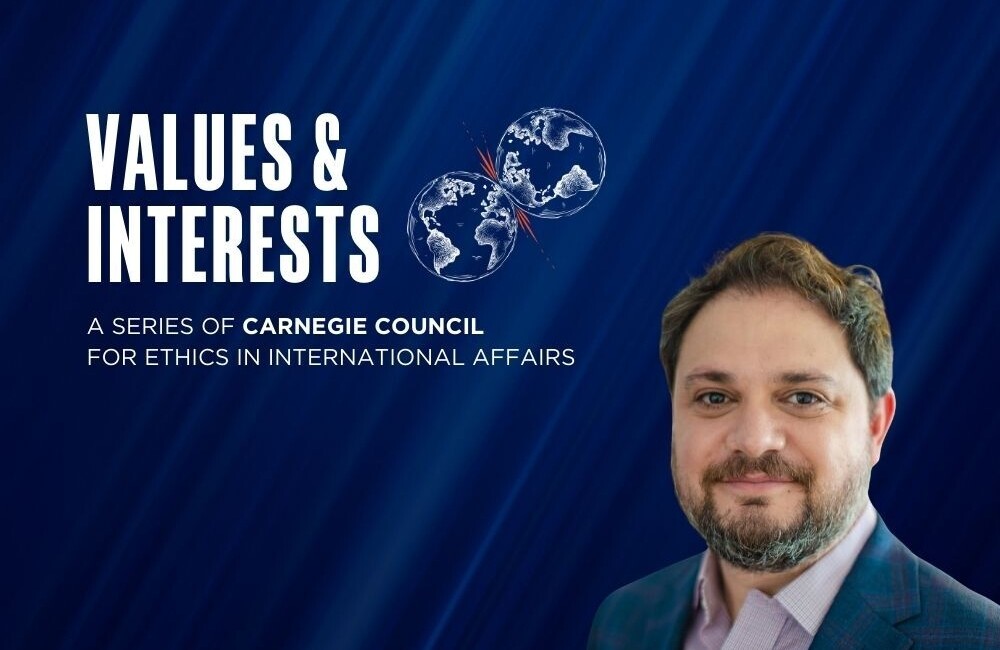
Invité

Matthias Spektor
École des relations internationales de la Fundação Getulio Vargas (FGV)
Accueillie par

Kevin Maloney
Directeur des affaires publiques, Carnegie Council
Pendant des décennies, les États-Unis ont fondé leur politique étrangère non seulement sur la défense de leurs intérêts, mais aussi sur des valeurs universelles telles que la liberté et les droits de l'homme. Mais que se passe-t-il lorsque ce cadre moral fondé sur les valeurs libérales disparaît ?
Des rues de Caracas au ciel de Téhéran, la puissance américaine ne se justifie plus par un discours d'internationalisme libéral ni par des appels, même symboliques, à des institutions telles que l'ONU. Au contraire, Trump 2.0 a adopté une approche plus explicite, fondée sur la loi du plus fort, qui rejette l'universalité et favorise le conflit civilisationnel entre l'Occident et le reste du monde.
Matias Spektor, professeur et doyen de la Fondation Getulio Vargas (FGV) à l'École des relations internationales, participe au podcast Values & Interests pour examiner les conséquences de ce changement dans le pouvoir américain et la manière dont la politique étrangère des États-Unis est interprétée dans les pays du Sud, où beaucoup soulignent depuis longtemps le fossé entre les principes américains et leurs pratiques sur la scène internationale.


KEVIN MALONEY: Hi, everyone. Welcome to the latest episode of the Values & Interest podcast. I'm your host, Kevin Maloney, chief public affairs officer at Carnegie Council.
So before we get into today's episode, I did want to take a moment to acknowledge the strikes by the U.S. on Iran that started on February 28. I think it's important context to note that this episode was in fact recorded a week prior to the start of the U.S. operation. However, this interview and our guest today, I feel very deeply could not be more apt and important for this moment. So I hope you learn as much as I did from our guest, Matias Spektor, professor and dean at the FGV School of International Relations in Sao Paulo, Brazil. Matias is a prolific writer and researcher on questions of geopolitics, power, and especially that relationship from a global south perspective. And with that, let's get right into the episode.
Matias, thank you so much for joining us today.
MATIAS SPEKTOR: Thank you for having me. It is a pleasure.
KEVIN MALONEY: On the Values & Interests podcast, the framework at Carnegie Council is that we do not like to bifurcate or separate the values aspect from the political or research aspect. I want to start by giving our listeners a sense of who you are as a person, your formation from a values perspective, and maybe some background on your career, and then we can get into the meat of the geopolitical moment.
MATIAS SPEKTOR: I trained in political science and IR as an undergraduate in the 1990s. I studied at the University of Brasília, which at the time was the only school in the whole of Brazil where you could take a degree in international relations.
Values-wise, that school was very much a school that has now become all the rage and it is in fashion in the Global North, which is the school of strategic autonomy. The idea that was prevalent in Brazil already then, at the height of the unipolar moment, was that there was real danger in globalization first of all and even more danger in a world out of balance, that having a single great power was bound to breed disaster because in the face of unchecked power what you have is the great power playing havoc with the rules and institutions of the system even if that power is the one that built that system in the first place. That is the school I came out of.
For my graduate work, I moved to Oxford in the United Kingdom and studied with a generation of scholars who had themselves been students of Hedley Bull and the English School, the idea that the reason that international society—of course, my second year as a Ph.D. student is when we had the Iraq War. At that time in Oxford the big tension was that, if you remember, George W. Bush was the U.S. president who claimed, and I think this is a direct quote: “There are no rules after 9/11.”
I come from a school in Brazil and then a school in Britain that was always extremely cautious and suspicious of unchecked power in general and U.S. unchecked power in particular and schools that always saw U.S. foreign policy not through the prism that is so common in the U.S.-centered conversation about world politics, which is the United States being the chief operator of the international order of our day, that it is the status quo power and these other challengers are revisionists—they may be the Soviet Unions, Irans, or Chinas of the world—rather than coming from a position that sees U.S. power as deeply revolutionary in the form of a Bob Kagan kind of world. That is my intellectual upbringing, if you want.
KEVIN MALONEY: Very interesting. I think that sets up the conversation well today.
What I want to do is think about this moment of transition. People talk about this in a hyperbolic way, but now everybody is talking about it post-Davos and post-Munich Security Conference, so I think we will just lean into that.
There is something happening in terms of the cycle of international relations and geopolitics. Sitting in São Paolo, sitting in a G20 country, sitting in a country that has had a swing back and forth from right to left governments recently, let’s flip the script in terms of not looking at this from a U.S.-centric perspective but looking at it from a Global South perspective. How are you seeing from Brazil right now the state of things, the order or disorder out there in the world right now?
MATIAS SPEKTOR: The first thing one should note is that for the majority of observers in the part of the world I come from the big transition that we are witnessing is a transition away from unipolarity into what most people in this end of the world believe to be an increasingly multipolar system.
I know there is a big debate. If you open the pages of Foreign Affairs magazine, you will see the majority of commentaries saying, “Well, we are not sure this is multipolar; this is unipolar still, militarily at least,” etc., but I think it is fair to say that from where I stand the world looks as if U.S. relative power has declined, has been declining, and is currently under Trump declining faster as power shifts away not only toward China but also moves away from the nation-state increasingly. Private actors are all the rage and all sorts of governance models beyond the state are so prominent, creating deep trouble in an age where coping with transnational problems has been a massive challenge, partly because traditional multilateral institutions have a hard time providing the collective solutions that they were designed to provide. That is the kind of big transition we are seeing.
The other thing is the specific shock of Trump, not only the new style in diplomacy, which is so different from what we have seen coming from the United States, although not entirely—and we can go into that in a minute—but also the deep impact that the world is suffering from now due to great-power competition. All the institutions we grew up with are now questioned. Their future is uncertain. It is so hard for anybody now to imagine what the world order will look like ten years from now because we are in this turbulent time when so many crises coincide, and there seems to be no single power that can lay down the law and establish a pattern of institutions and norms to regulate things.
KEVIN MALONEY: I want to pull on that thread a little bit in terms of the changing moment and outside of the “great powers.” What does this moment mean, especially the decay of those institutions, the principles, and the rules you talked about?
Early on last year, so early on in Trump 2.0, on the podcast I was speaking with Ambassador Ali Nasir Muhammad, who is the ambassador from the Maldives to the United Nations. He talked about, especially from a Small Island Developing States perspective and from a Maldives perspective, this tension in terms of simultaneously understanding—and you see the effects of climate change—the impact of some countries not playing by the same rules as others, but then making the statement that the Maldives survives security-wise and economically because of the international system, so there is this tension there.
You talk about this tension in terms of wanting to change the system but also having protections under that system. Maybe we could get into the nuance around that because I do think that is a space, at least in the policy-to-politics world—we are seeing it a lot in the IR debate world—where it is not a nuanced conversation a lot of people are having right now.
MATIAS SPEKTOR: What we can say is this: After the end of the Second World War, when the institutions and norms that we grew up with were created—the United Nations, Bretton Woods, the North Atlantic Treaty Organization, etc.—these were mostly institutions built by what we now call the Global North. Sometime in the late 1950s and early 1960s a coalition formed of post-colonial countries that became a fixture in multilateral institutions. They became a coalition, they had a joint project, and it was all about national autonomy, sovereignty, the principle of nonintervention, and so on.
For decades now, countries outside the North Atlantic have been demanding changes to the system, but it is very imprecise to suggest that these have been countries with a revolutionary agenda. They are far more moderate reformists because they are so dependent on the system and because, by and large, they benefited enormously from many of the features of the system.
My own country, Brazil, was a rural economy in the 1950s. It had lots and lots of problems regarding development, diplomatic activism, and the ability to shape norms and rules. When you compare that to what we have today, there is no aspect of Brazil’s international life, be it in the economic or security realms, that is not deeply intertwined with the norms and institutions that were created after the Second World War. Brazil still has a deep stake in the survival of the system and in the major powers being constrained by international law and institutions.
Do these countries want to change the norms and institutions? Yes, but to what effect? Not to get rid of them but to improve the space these institutions and norms provide for these countries to flourish rather than chuck them away.
KEVIN MALONEY: You alluded to this pragmatism that was there. Although it was Global North dominated, even if you look at the number of UN Member States, it gets increasingly larger as decolonialization happens.
I have been thinking a lot about this missing good-faith pragmatic space. On one end of the spectrum, I am thinking about the massive short-termism in terms of politics right now, where it is like “win the information ecosystem of the next hour,” and then you have this long-termism in terms of tech companies and people who are not invested in a pluralistic system long-term; they are invested in “winning the future,” whether that be going to Mars, making sure there is a robot in everybody’s house, or fill in the blank.
One of the lines that jumped out at me in a recent piece you wrote for The New York Times talked about state sovereignty from a Global South perspective as this “hard one thing.” There is still proximity to winning that.
Moving forward, how is the Global South conceptualizing sovereignty or its own security in this environment as you said with new actors who are not necessarily thinking this international system is what is going to be around in five years, let alone next year?
MATIAS SPEKTOR: That is a great question. If you look at the evolution of the norm of sovereignty across the Global South, what you will find is that the vast majority of countries have a very live memory of what it was when these countries were either colonies or had been very recently colonies, if not formally then informally. The idea that you can actually manage to secure autonomy in the way you do policymaking in your capital city has become a quest for the majority of these countries.
Another idea that comes up very prominently is the notion that for you to let go of sovereignty you need to have a very strong state. It is not any country that can let go of monetary policy and decide to set up a European Central Bank. You need to be a Germany or a France in order to do it. You cannot expect relatively weak countries or countries that only yesterday felt they were at the receiving end of a neocolonial imposition to do that.
One of the tragedies of the current day is that concerns with sovereignty have become dominant once again even among big powers. The United States has a concern with sovereignty. You could run a presidential campaign that is successful on the idea that you need to win back control, that you will not let international institutions shape your policymaking process.
If you go to Europe, it is the same. The “Year of European Strategic Autonomy” as a goal is now back, and you hear it in the voice of the German chancellor, let alone with the Putins and Xi Jinpings, where these ideas have been prominent for a very long time. We are back to a world of hard-power, sovereigntist, deep uncertainty, and suspicion of international institutions.
The tragedy, Kevin, is of course that as scholars have shown time and again it is so difficult to produce collective security if you do not have institutions that can reduce the costs of cooperation. The fact of the matter is that as we move to a world that is highly competitive geopolitically and where there is so little trust even among allies, the danger is that these institutions decline and with them our collective capacity to act. As we saw during the COVID-19 pandemic, when the world fails to pull together, that breeds trouble.
KEVIN MALONEY: From a Carnegie Council perspective, we think about multilateralism or international cooperation as a political principle but also a moral principle. You have talked a bit about this in your recent writings, especially around the turn from I would say values-based engagements or reciprocity through diplomacy to transactionalism. Can you talk about how you “look under the car hood” on something from a diplomatic or security perspective on building something around transactionalism versus the system that we had that might have been a mix of interests and values-based previously?
MATIAS SPEKTOR: Traditionally the United States, and to a large extent Europe after the Second World War, used the language of the “provision of global public goods,” the idea that a lot of what they do is of course centered on self-interest, but at the same time a lot of what they do is about managing the world, providing for others, and securing the structures of an international order. That language has been honored and abused at different moments in time.
Transactionalism is not new and is not unique to Trump alone. We have seen transactionalism in the way the United States has operated all the way back to inception with President Franklin Roosevelt (FDR). That is not new.
What is new is that at least from FDR onward but certainly before FDR as well the United States couched its foreign policy in a language not only of interest but of values that attended to the interests of others, the idea that this is a hegemon but a hegemon that is easy to join because it provides an awful lot for the rest of the world and holds certain values that are universal and in the Declaration of Independence, and it has been repeated by almost every U.S. president since.
Outsiders could look at this and say, “Well, what a source of inspiration,” and the United States has provided a powerful source of inspiration for revolutionary movements, independence movements, and progressives around the globe for more than 200 years now. At the same time, outsiders could look at this and say, “My goodness, what hypocrisy,” because oftentimes there is a disconnect between what the United States says and what it does, and better alternatives were available that the United States chose not to follow, and the United States retains this language of moral superiority, so there is an element of deception that makes outsiders squirm at the language of U.S. foreign policy. That had been the norm.
The new thing now with Trump is that he does not couch U.S. power in the language of moral superiority. He does not claim that the United States does what it does on the alter of principles that are morally superior and therefore the others should accept the authority of the United States because after all the United States is such a benign hegemon. He has none of that.
He is far more amoral in the way he speaks, and this creates all sorts of dynamics that are new. The first one is that it is very hard to hold his feet to the fire. It is easier to criticize George W. Bush for the use of torture in Abu Ghraib because the argument for going into Iraq in the first place was an argument about freedom and security. With Trump there is none of that, so what do you hold him to? Being unable to hold him to anything is not something that only happens to outsiders; it happens to the opposition party inside the United States, it happens to committees in the U.S. Congress, and it happens to the U.S. media.
Amoralism depletes the resources that others have to try to hold power accountable. That is a big change I think in the way the United States behaves and others are or are not able to respond.
KEVIN MALONEY: There is a lot there. At the Council, and listeners will have heard me talk about this, we think about this normative spectrum of post-World War II U.S. foreign policy being between liberal idealism and amoral realism. From an optimization standpoint, it is manifest as maybe a president or Congress that would be pragmatically idealist. You think of the North Star in trying to strive toward that.
I think there is another layer to the Trump transactionalism, and you compared that to FDR, and there is a lot of nuance there. I would say that the difference is the type of transactionalism in that there is a direct benefit to Trump and the people around him now, so it is not just a transactionalism from a state-to-state perspective. The norm has shifted within the Oval Office in terms of who is benefitting, and there is not even a good-faith attempt to hide it. It is not even something like: “Oh, we invested in this and it is coming out five years from now where Dick Cheney was on a board or President Obama was invested in X.” It is happening almost in real time day in and day out. It definitely I will say an “interesting” moment.
I want to turn to this line you have in one of your recent pieces: “The disappearance of hypocrisy can be thought of or seen as progress.” Can I get you to expand upon and react to that line, which of course you drafted?
MATIAS SPEKTOR: Right. For a lot of folk outside the United States Trump has been a bit of fresh air because he does not sound like a hypocrite. I will give you an example: When President Biden took office, one of the big flagship initiatives was the Summit for Democracy, but at the same time the United States was sponsoring a Summit for Democracy, President Biden was traveling to Riyadh and being chums with Mohammed bin Salman. For many people, that smacked as something odd.
Also, the fact that the Israel-Gaza tragedy happening awoke in people a sense that double standards were the norm because all of a sudden you had officials from the United States and European Union chiding the Global South for not being tough enough on Putin even if Putin was massacring and killing lots of civilians in Ukraine, yet not one word about civilians in Gaza being killed in overt violation of international norms.
When Trump comes to office and talks as he does, many people reacted by saying: “Well, at very long last the United States that you see is the United States that you get. No surprises there. He is not being deceitful. He is being truthful. We may not like what we see, but what we see is at long last what we get,” rather than this duplicitous, conniving attitude where I impose my fist of iron but cloak it in a silk glove.
I do not agree with that view and worry enormously about it, precisely because of what I was saying in response to your last point, which is that when you are able to call on someone for applying double standards, saying one thing and doing another, you have leverage right there to demand that they do better. They may not do better, but at least you have a tool with which to try to constrain them. The minute that goes, you have nothing because we are in a world of coercive diplomacy alone, and that is a despairing world for countries that don’t stand a chance in a world where it is coercive diplomacy that gets you places.
KEVIN MALONEY: For people in the IR or geopolitics space this year has felt like a lifetime in terms of trying to keep up with the news. One of the deeply disturbing things of the past ten days was the speech that Marco Rubio gave at the Munich Security Conference, and I want to get your reaction to it. I took some days to reflect on it. In comparison to the JD Vance speech, it was more palatable, seemed a little more friendly on the surface, and everybody in the room stood and gave him a standing ovation.
As I got a few days away from this the image kept coming to my mind of almost starving people in a room and throwing them a piece of bread, and them getting up and kissing your feet or cheering for you. It felt like the norm has been changed so much in terms of what Europeans expect or need from the United States. It was a moment when I could not square that circle.
Underpinning it for me was a deeply disturbing narrative around different civilizations having different value, literally ranking civilizations differently. This goes to what you said before, that at least there was a framework around the universality of the equal moral worth of every person. Yes, we might have tripped and had bad-faith actors, and there are so many examples, but at least that was there as an organizing thing, and now it seems it is the blatant opposite: They are literally tiering how different societies are better than others.
Sorry for the long windup, but this has been on my chest for about a week now, and I want to get your reaction to that and maybe how you viewed the Security Conference and the speech.
MATIAS SPEKTOR: I agree with you, and I would go a step further to suggest that again this is not entirely new.
Go back with me in time. If you remember, when Obama first appeared on the national scene and it looked like he might have a chance to win the presidency, the rest of the world gave a big sigh of relief because the world had grown accustomed to the War on Terror that had been applied in ways that violated international law and produced a massive disaster in Iraq and Afghanistan.
When you had officials in and around the White House publicly defending the use of torture in the “Land of the Free” and when you had racial profiling going nuts, discrimination not only about people of Islamic faith but the Arab world in general and even Arab American communities, and all of a sudden Obama, who spoke in terms of universal values, captured the imagination of the rest of the world. Obama won the presidency outside the United States way before he won it inside, and you will remember the crowds that came to see him in Berlin as he was campaigning. My goodness, the man won a Nobel Peace Prize soon after taking office and before having secured any meaningful peace.
This is not the first time that we see a president of the United States who tends to ignore international law, international norms, is “America First,” and is willing to do all sorts of compromises to the horror of audiences outside the United States. Therefore, when these people hear something different they rally, and it makes a big difference.
We can go further back in time. I think one of the most interesting exercises is the story of President Reagan, who is seen by and large inside the United States as a beacon of freedom and prosperity in the world, the man who fought the Cold War and won it and who expanded liberty to Eastern Europe.
Yes, but President Reagan is also the man who used force certainly in the Caribbean, my part of the world, but also in the Middle East in ways that were highly questionable and involved lots of accusations of corruption of course, but also he was someone who was willing to support dictators as long as they were friendly dictators, and not only support them but actually empower them via the Kirkpatrick Doctrine, whose author was President Reagan’s ambassador to the United Nations.
This is not the first time. We have been in a place that was similar before. Of course, it is not the same, but this is not entirely new, and my guess is that this too will pass and the time will come when there will be a president of the United States who will restore the language of universal values moving forward, or so one hopes. I don’t know.
KEVIN MALONEY: From a U.S. perspective right now it feels that there is a layer of transactionalism, and I am going to posit another layer here. I completely agree with what you said.
A big point of difference from a U.S. perspective is whether it was Bush, Reagan, Nixon, whether Watergate, Abu Ghraib, or Iran-Contra, there was still that thing that allowed them to be checked and to pay a political price. The norms around that are shifting so quickly in the United States right now. Will they still have to pay that price?
This is the big question in terms of a pluralistic versus anti-pluralistic future. The midterms are going to be a big point as a marker for that moving forward.
We talked about the idea of, “You don’t know what you have until it’s gone,” from an international perspective, albeit flawed. If this was what some presidents were willing to do with significant checks from an institutional perspective, what does that look like with hard-power, technological, and economic capabilities unchecked? That is a very scary scenario for me and is I think a fork in the road is coming up. This could just be the beginning of a much darker trail. We are thinking about this a lot at the Council, so I want to get your reaction to that.
MATIAS SPEKTOR: I am so glad you bring this up, Kevin. I entirely agree.
The U.S. political system is so distinctive and has this peculiar design of checks and balances that largely determines the extent to which whoever is in the Oval Office can or cannot do certain things abroad. For audiences outside the United States, whether there are checks in place makes a hell of a difference.
The one thing that I think mystifies most observers of the United States outside it, including myself, is the fact that unlike the case with Nixon, Reagan, and George W. Bush, for some reason the way the U.S. political system has evolved is such that it seems to be the case that whatever checks operate on the current president are at the level of mass publics and mass public opinion, and it will be voters in the polls who will exercise some constraint.
It is mystifying for outsiders what is happening with the Democratic Party, the Republican Party machine, and the Supreme Court. For the first time in my adult life, this has opened questions which I never thought I would encounter as a younger training political scientist: Is the United States a functioning democracy? Is authoritarianism creeping into the body politic of the United States?
I cannot remember a point in time when I thought this was a real threat, and yet here we are and these are the terms of the conversation. That resolution in U.S. domestic politics will have so many ripple effects across the world that I entirely agree that this to a large degree is what the future depends on. Which fork in the road are we going to take?
KEVIN MALONEY: The difficult question of thinking about these things in practice is that there are inherently ethical values—I am referring to the frameworks of the Council—in making sure that international systems are as equitable as possible, and we think about that as maximizing universality and basically human security and flourishing within that.
However, we are not divorced from an understanding of power, so a lot of what we think about is this Hans Morgenthau relationship between values and power, and what does power mean within democracies? How can it be tempered? How can it be shaped? It has to start at power.
I think whether or not we are seeing the decay of international law at this moment is not because of international law. The laws have not changed necessarily, but it is because powers are not underwriting or prioritizing them as they used to.
There is a constant tension around wanting to be more equitable but also accepting the power realities of the moment, and I think we have seen the speed at which not paying attention to the power realities politically or geopolitically, if there is one person at the helm who is given all the power: Climate change regulations in the United States, gone; regulation of artificial intelligence (AI) companies, gone.
I am not saying that as eloquently as I should, but I think there is a tension there. People want to go in a positive direction and have the same moral and political North Star, but a lot of times there is tension between this power and this values dynamic, be it geopolitically in multilateral institutions or even domestically in the United States.
MATIAS SPEKTOR: That is great. Let me respond. In a world of unchecked power, the guy at the helm can lay down the law on the others, and that can be terrible for the others, but the guy at the helm could be inspired by universal values and believe in certain principles that help shape a world that is not a world of pure hierarchical imposition.
The problem is that now—and this compounds everything we have said—power is far more checked, and even if there was a president of the United States who wanted to expand the range of norms and institutions that provide global governance, this person would have a far harder time laying down the law and writing the new rules of the road than, say, George W. Bush could after 9/11 or Reagan in the long 1980s because now U.S. power is checked in ways that we have not seen for a long time.
Of course, you will get the counterargument of that, saying: “Well, militarily the United States is still number one, and can’t you see what we saw with Maduro in Venezuela, what is likely to happen in these coming days in Iran, and so on?”
Look at China and Russia doing what they can to puncture U.S. hegemony in the South China Sea and Eastern Europe, respectively, and at the way countries in Africa, Latin America, and the Middle East now deal with different expressions of U.S. power. Look at the condemnation of Israel for genocide in the International Court of Justice. Look at responses to the new wave of the War on Drugs, and you will see that it is far more difficult for the United States, under Trump or any other president, to be the chief designer, architect, and operator of international order.
The fact is that we have not been in a system with more than two great powers for 80 years, and the scant memories we have of that are not happy ones. Go back to the 1930s or the 1910s, the prequels to great-power war. We have to go all the way back to the 19th century to remember what it was to be in a multipolar system where the major powers were not in constant war against one another, and even then the amount of violence in the international system was enormous compared to what we have grown accustomed to in the age of bipolarity, the Cold War, and the age of unipolarity post-1989.
KEVIN MALONEY: We talked about this before we started recording. It is a very dangerous time but also a very interesting time from a global order perspective to be thinking deeply and writing about this. It is certainly a moment, and I will leave it at that.
I think so often the narratives that we are being fed are so U.S.-centric or so European-centric. You are sitting at this amazing university in Brazil and thinking about these global-order questions. For my audience, where should we be going to read and get information from a Global South perspective about this moment of international transition? This is for my own selfish reasons as well, but I would love to hear your thoughts on resources.
MATIAS SPEKTOR: I will tell you what. When I got the invitation to come onto this podcast, the first thing I did was click on who you had interviewed in the past, and I was taken aback because I am used to going into these types of podcasts and seeing the usual suspects from, say, ten universities around the Global North exclusively, and your podcast is genuinely global. Immediately I said, “Of course I want to be there.”
What I would encourage people to do is try to remember these basic principles of international politics: What you see very much depends on where you sit. The idea that China is a threat is a dominant idea in many parts of the world, but it is not a dominant idea in many other parts of the world. The idea that Putin is an authoritarian killer of civilians who will stop at nothing after he expands the range of his borders to recreate the Soviet empire is a dominant idea in some parts of the world, but it is not at all the dominant idea in other parts of the world, where Putin is seen as someone who has managed to use force to deny U.S. hegemony in Eastern Europe, and that is a source of stability and not instability. I know it sounds odd, but you find those kinds of arguments in some places.
I would encourage people to try to listen to as many different arguments as they can, and that means of course attending to sources that are not obvious, and to the degree that is possible try to widen the range of messages they listen to. I certainly try, but of course in an integrated, globalized world it is so hard to do. The barriers are so evident, language being one of them.
KEVIN MALONEY: Yes. I think it is a personal challenge to be comfortably uncomfortable, and then there is a bigger challenge, which is harder for the individual to sort through right now, which is understanding good-faith versus bad-faith sources and information, even if they have a political bent to them. The “Ai slop” is coming. We are seeing the deepfakes of John Mearsheimer on YouTube. Again, it is an interesting moment. I fully agree with you. I think the push to have oneself do that regarding information aligns with our pluralistic approach here at the Council.
Matias, thank you so much for joining us today. I appreciate it.
MATIAS SPEKTOR: It is my pleasure. Thank you.
Carnegie Council for Ethics in International Affairs est un organisme indépendant et non partisan à but non lucratif. Les opinions exprimées dans ce podcast sont celles des intervenants et ne reflètent pas nécessairement la position de Carnegie Council.


